Order of Arnath


Home page for Order of Arnath

The Order of Arnath is a martial order, founded in the Northern reaches of Faedrun several hundred years ago. They were very heavily involved in the war against the Undead, helping to hold the North far after it should have fallen, but at great cost to themselves. Battered and broken, the Order sent many refugees to Mardrun, where they immediately began building a fortress. Starkhaven, as it is now called, is the second-largest colony on Mardrun.

Arnath – Religion and Beliefs

Order of Arnath’s Light Library – The Order has always been keepers of knowledge as well as warriors. Their Library is open for all to peruse, though some items may be restricted.

Order of Arnath on Faedrun

Order of Arnath on Mardrun

Starkhaven

Ranks

Playing an Order Character

Media

The Mardrun Trade Consortium

The Mardrun Trade Consortium

Most commonly known as simply The Consortium, this faction is small and barely out of its infancy. So far they have had some dealings with New Aldoria and the Pheonix Syndar, but they are always looking for opportunities to expand their trade to further reaches of Mardrun.

The faction was established by a group of friends and traveling companions who, having survived the destruction on Faedrun, now seek to establish themselves in the new world. The Consortium is not merely interested in the acquiring of wealth, but in the improvement of Mardrun as a whole. They seek to make it safer and easier to get affordable, quality goods and services to as many people on the continent as possible. Their motto “exaes erigit omnes naves” or “a rising tide raises all ships” speaks to this intent. They do not have any specific allegiance to any nation or race and welcome anyone to their ranks who is willing to pull their weight.

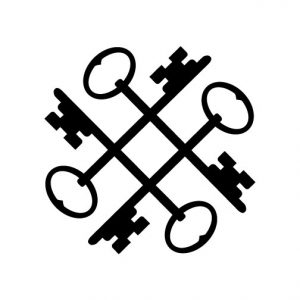
Their emblem is four crossed keys, which marks their goods, caravans, and any personnel employed by them. The more complex version has the emblem in red on a background parted “per cross” in black and white.

The Pirates of Oarsmeet

The Lost Aldorians

Established roughly a century ago, Oarsmeet was once a small fishing village barely within the borders of the Kingdom of Aldoria. As the years passed, the village grew, and with it, it’s reputation. thieves, thugs, and pirates were slowly drawn to the port town: some for the promise of an easy fortune taken from the unwary or unwitting; others for the call of danger. Still more came for a fresh start, as the law enforcement in Aldoria seldom bothered with such a remote little village, leaving criminals with a chance to lay low for months on end.

Around the time of the undead attacks, Aldoria saw the threat posed by a town of pirates as they prepared to sail across the sea to the new continent, and eventually dispatched a crew of sailors and soldiers to dispose of the vagabonds as quickly as possible to avoid any future confrontations. The crew, led by Commander Jackston Ridgebon and his second, Lieutenant Anne Cash, set sail immediately for Oarsmeet. By the time they arrived however, the attacks were growing more and more persistent, with the people of Oarsmeet struggling just to weather the waves of attacks. Commander Ridgebon, with his orders strengthening his resolve, was content to leave the scene and simply wait for the pirates to be overrun by the undead. He ordered his crew back onto the ship to return to Aldoria.

A handful of sailors, Lieutenant Cash included, refused to leave. They felt that it was their duty to the people of Aldoria, even if they were criminals, to ensure their safety however possible. Commander Ridgebon gave them a lifeboat and sent them ashore, deeming them deserters and criminals, just like the lot they were going to try to help. Between the ingenuity of the criminals and the discipline of the sailors, Oarsmeet soon had a simple guard set up, resilient enough to hold off the undead and Penitent long enough to evacuate the town.

By commissioning the aid of a local pirate by the name of “Mad Morty” Blackwaters and his ship, the Blue Ruby, as well as a few other vessels, Cash and her fellow deserters were able to secure passage to the new continent. After weeks of increasing aggressions by the undead, the citizens of Oarsmeet were finally ready and able to leave their homes, once and, some feared, for all. As the women, children, and elderly began to board the vessel, one of the town’s scouts burst into the barracks (once a minor gambling hall that had been repurposed out of necessity), a bite wound in his right arm. The blood drained from his face as he collapsed, uttering two final words with his last breath, “They’re close.”

As the guard scrambled to form some sort of defense against the imminent attack, a small horde of Penitent erupted from the woods near the village, charging the town, eager to spill blood that night. They set fire to houses and swarmed around anyone they could find, like a hive of bees insistent on stinging a target to death before moving to the next. Sensing that defeat would soon be upon them, Cash ordered the retreat back to the ships, and to shove off once they were full. Sailors covered the retreat, as pirates helped with wounded onto the ships, each ship setting sail when they could no longer afford to take on another passenger. Finally, all that remained were the sailors who had so far survived the attack, who began to board the final ship in the dock, the Blue Ruby herself.
With no force rallied against them, the Penitent rushed to the shoreline and unleashed volley after volley of flaming arrows towards the ships. Sails were ignited, leaving the ships and their passengers sitting like ducks in the water. Some had holes burned in their hulls, dragging the passengers down to a watery grave. In all, of the seven ships gathered to transport the citizens of Oarsmeet, only two, The Blue Ruby and the Interceptor, a small vessel carrying many of the wounded soldiers, survived the onslaught. Still they sailed, always looking back to shed a tear and share a song for those who died that day.

To the New World
During their voyage, the two ships were blown slightly off course, landing not on the shores of New Aldoria, but rather on a seemingly uninhabited beach. They would soon learn, however, that this was not the case at all. Shortly after reaching the shore, a forward scout reported seeing movement in the forest. “They looked like men,” he began, short of breath from both fear and exertion, “but they moved like wolves. Animalistic. As a pack. Right this way.”

As the scout had warned, soon enough, the pack of eight was upon the settlers, encircling them as a pack of wolves would do. A large male clad in bear fur approached Mad Morty. “You are in Grimward Territory, outsiders. Give me one good reason not to cut you down where you stand.” The answer the settlers gave made no difference. These Ulven were hostile, and saw the Aldorians as invaders. Weapons were drawn, threats were made, and taunts exchanged. Two Aldorians fell to Ulven blades, while an Ulven took an arrow to the heart, collapsing with a mighty thud. The Ulven retreated, their skill, great though it may be, was insufficient to overcome the dozens of settlers they faced. A promise was made, though, for the Ulven to return, that the Aldorians may never know peace from their wrath.

An Ulven promise made is a promise kept, and the next day, another small pack came to the encampment to harass the settlers, throwing rocks and insults, seemingly reluctant to strike the first blow. The Aldorians had banded together and soon set about constructing proper, if slightly crude, buildings. Stone walls and wooden fences, roofs to shelter them from the elements, and a roaring bonfire to drown out the howls of their Ulven tormentors.

No Ulven came that night, nor the next. For a week, the Aldorians slept in a wary peace, ever watchful of their new, distrustful neighbors. On the second night, a scout failed to return. Lost, as most had suspected, but none knew how right they were. On the third night, the scout was found. Scattered throughout the forest, torn apart, large chunks of flesh missing from his limbs and torso. A look of pure fear, unlike any seen since the first undead attacks, frozen on his lifeless face. On the fourth night, two more scouts disappeared, only to be found in similar grisly states the next day.

A war party was formed, two dozen able-bodied fighters and clerics strode into the first Ulven camp they saw. Accused of committing these acts, the Ulven seethed with rage. Despite the hatred they felt for the intruders, the Ulven live, fight, and die with honor. They would not stoop so low as to defile a corpse in such a manner. “This is the work of the Mordok.” Ulven fists clenched and jaws tightened at the mere mention of their mortal enemies, while a look of fear came over the Aldorians.

“What the hell is a Mordok?” Lieutenant Cash, now known as “Bloody Anne”, First Miss of the Blue Ruby, asked, more furious than scared.

The bear-clad Ulven from several days before let out a loud chortle, rippling out to the surrounding few, until the entire camp had joined in to mock the foolishness of the invaders. “Good luck, outsiders. Now,” he added, reaching for his massive axe, leading his companions to do the same, “Run back to your little cottages before we show you the meaning of Grimward hospitality.”

So the hatred between the Aldorians and the Ulven festered like an open wound. Raiding parties would be sent to steal supplies, burn buildings, and slaughter livestock the other would deem a necessity. Skirmishes would break out on regular occasions, although all-out warfare had yet to erupt.

The Aldorians would not actually see a Mordok until a week later, when the curious monster was attempting to free itself from a bear trap laid by an Aldorian hunter. It shrieked at the sight of the stranger, more startled than frightened, and in it’s panic, tore the flesh from it’s leg as it bolted into the woods. Soon enough, though, the hunter felt eyes upon him. He was also being hunted, and took off for the camp. As he made it into the clearing, a Mordok leapt towards him and grabbed his ankle, knocking him to the ground. The guards on patrol heard his cries for help and rushed to his location, but all they found by the time they arrived was a bloody trail and several sets of footprints that seemed almost human. A search party was assembled, and they set off after the beasts, following the trail of blood. Almost two hours later, they found the hunter, nearly unconscious, with his back against a large boulder and a dagger in his hand. Three of the black skinned monsters were circling him, while another lay dead and bleeding at his feet. These were hunters themselves, and knew that he would not live much longer one way or another, so they waited. The search party managed to slay one of the creatures, and drove the other two off, carrying the wounded hunter back to camp to patch him back up. This marked the first time a Lost Aldorian had encountered a Mordok and lived to see the light of day again.

New Oarsmeet and the Pirates of Aldoria

A number of years have passed, and the small band of survivors has truly established themselves in the area, as a town they designated New Oarsmeet. Sturdy log walls encase the town, and squat stone buildings crowd the land, homes and businesses for the Aldorians. Clan Grimward’s raids have only intensified: Cattle are no longer the object, as they have found a greater use for captives.

The citizens of New Oarsmeet, while they do grow some of their own food, and have taken to looting whatever they can from Ulven outposts in the area, have found their stores running dry faster than expected. As a result, the Blue Ruby will occasionally take to the sea once again, in hopes of finding a merchant vessel or the like, something heavy with coin or supplies. The piracy is a blast from the past for some, while others have a a slightly harder time justifying the theft of food from those who may also need it, but starvation can be a powerful motivational tool, and these individuals eventually agree that it is for the best.

New Aldoria has reached out to New Oarsmeet on more than one occasion, sending a delegate to the town in hopes of convincing them to rejoin their former brethren. Feeling abandoned by the crown and the ideals it supposedly represents, however, these Lost Aldorians, also known as the Pirates of Oarsmeet, have rebuffed these offers time and time again. Until they feel Aldoria has been returned to her former glory, until she is once again a force to be reckoned with and a benevolent hand to be loved, they will refuse to acknowledge the ruling class of New Aldoria. Still wearing the Green and Blue of their homeland, the Lost Aldorians have added the color purple to their uniforms, often in the form of a scarf or flag worn on the belt, to represent the royal family to whom many of them still feel they owe allegiance, as well as the blood spilled in the water as they fled their home.

While they do not care for the nobles of New Aldoria, the Pirates of Oarsmeet try to maintain pleasant relations with the common folk of their homeland, and will readily accept aid and commerce with other nations. Their opinion of the Ulven has been tainted by Clan Grimward, since you never get a second chance at first impression. Clan Grimward continues to plague New Oarsmeet with near constant raids, although the Aldorians have learned to better handle the situation, and supplies they have received from trading with other nations have restored morale and saved many lives. To this day, they are distrustful of Ulven culture, even among friendly clans, although they have resolved themselves to an uneasy peace with them.

Known Members:
​”Bloody” Anne Cash

Boz Mezar

Heraldry
– May’Kar Dominion tabard or belt flag with white palm tree over white crossed sabers on a blue background
– Serai Battle Standard

JN1022-zoom.jpg

Official Background Story
Boş Mezar \’bowsh ‘meh’zar\ is the action arm of the May’Kar settlement Serai \’sir’aye\. It is a mercenary organization specialising in area defense and force education. Odd for a mercenary band in that it abhors all loss of life, Boş Mezar nonetheless offers a multitude of martial services including but not limited to: area defence, area denial, executive protection, armed transport, battlefield preparation, battlefield healing, housing of detainees, intelligence collection, and peacemaking. Boş Mezar also offers consultation and training including but not limited to, small unit tactics, battlefield management, campaign planning, skill training (primarily combat skills, although additional skill training may be available upon request), convoy training, opposing force simulation, and simulated area assault.

The settlement of Serai was founded with the stated goal of May’Kar cultural revival. Due to the low numbers of living May’Kar and continuing persecution from other immigrants from Faedrun, Serai made the choice to actively hide its existence and abstained from world politics. It remained undetected until scouts from The Brotherhood of the Long Winter looking for a suitable location to establish a settlement of their own made contact in 263. Finding in The Brotherhood a group that didn’t reflexively blame all May’Kar for the betrayal, Serai welcomed the new settlement on it’s doorstep. Although The Brotherhood’s proximity provided a welcomed deterrent against foreign aggression, the Citizens of Serai were unwilling to trust them with the entirety of their defence or to represent them to the outside world.

Boş Mezar was formed in early 264 to provide a means for the May’Kar settlement to once again interact with the world writ large. It is charged with protection of Serai, locating surviving May’Kar and inviting them home, spreading May’Kar culture, and making manifest any edicts of Serai. All May’Kar are welcome within Serai, and all people with appropriate skills and a willingness to further May’Kar culture are encouraged to apply for membership in Boş Mezar regardless of race or background.

New Aldorian Marines

Founded in the year 228 under orders by the King of Aldoria, the Marines were created as a response to the Vandregonian Rangers: Elite soldiers trained not as front-line fighters, but as a task force designed to operate with surgical precision. Chosen from the ranks of the Aldorian Navy for their skill, resourcefulness, and experience. After the Fall, many Marines lost their lives covering the retreat of the Aldorian settlers or protecting their ships from pirates at sea. The group had fallen into ruin in the New World, but at the behest of Prince Aylin, was reformed in the year 264 under the leadership of the former Aldorian sailor and former Pirate, Anne Cash. While an official uniform exists for formal occasions (Black pants and boots, Blue naval coat with a green sash), most Marines show their allegiance by prominently displaying both a blue and a green sash on their person.

Being of Aldorian descent is not a requirement to join the Marines: you simply need to be loyal to New Aldoria and skilled enough to live up to the reputation as a Marine. Most members are invited in, although an interested candidate can petition to join, at which point they will be tested and evaluated to see if they are a good fit for the group.

Not all associated with the Marines are warriors or fighters, though. Healers, smiths, tradesmen, and politicians all have their place in the Marines. Although they are seen as support roles, they are just as valued to the organization, with ranks determined by merit in each perspective role.

The defense of New Aldoria is paramount in the eyes of the Marines. Second, the Marines are committed to each other: no one gets left behind. Behind this is a devotion to personal and unit excellence. Whether through training and drilling, studying, or practice, the Marines strive to be the best in all they do. Marines are expected to better themselves, and when training, they are encouraged to expose flaws in a squadmate’s form to close those gaps. A missed parry can be dangerous, as can a wound improperly treated. Even a false bit of information can lead to unnecessary danger for yourself and your squad. Criticism is not just expected, but encouraged, as long as it remains constructive.

Marines are expected to respect the chain of command inherent in their organization. Orders from a superior are to be followed, unless doing so would put you or your squad in unnecessary risk. Subordinates may not give orders to superiors, although their input should be given appropriate weight and consideration.

The ranks of the Marines, from Lowest to Highest, are as follows:

  • Private: The lowest ranking member of the Marines, this level is usually reserved for new recruits, although demotions for insubordination or poor decisions may result in this rank, as well.
  • Corporal: The first step up from Private, this rank is granted to those who have proved themselves capable in some manner or another. Most Corporals are trained soldiers, although many who fill this rank are also skilled tradesmen, devoting their trade to the organization.
  • Sergeant: For those of exceptional skill and determination, the rank of Sergeant is a badge of honor. They are the leaders of the lower-ranked troops, the lowest-ranking Officer rank, and often the ones put in charge of battlefield tactics and day-to-day operations during peacetime.
  • Lieutenant: The most trusted officers of the Captain, the Lieutenants are hand-picked to be the best of the best of the best. It is common for the Captain to appoint areas of responsibility to each Lieutenant, to avoid infighting should the Captain fall.
  • First Lieutenant: The Captain’s second-in-command, this Lieutenant has been elected fit to take over in the unfortunate case of the Captain’s demise. The Captain is not required to nominate a First Lieutenant, and in such a case, a new Captain will be chosen from the ranks of the Lieutenants by the Master General.
  • Captain: The highest rank achievable by a member of the Marines, the Captain oversees the entire organization, answering only to the Master General. Currently there is only one Captain, although the rank may be expanded in the future if deemed necessary by the Master General.
  • Master General: The reigning monarch of New Aldoria. The Master General has complete autonomy over the Marines and has the final say in all of their decisions, although these decisions are often left to the best judgement of the Captain.

The Marines rely heavily on their squad mates for their success, and their very survival. As such, insubordination is dealt with swiftly. Reports of insubordination should be brought to the Captain directly, or the next highest-ranked officer if the Captain is not present. Both parties are expected to respect the Captain’s verdict, although the decision can be overturned in the presence of new evidence. It should be noted, however, that false claims of insubordination will be punished just as harshly as the crime itself.

The March of Starkhaven

The Beginning: A New Chapter of the Order – Arnath’s Light

After years of decay and financial distress, the once great settlement of Starkhaven had descended into near ruin. Many settlers fled to other colonies. Although the military might of the Order of Arnath has never recovered from the initial conflict with the Ulven and the recent Ulven civil war, a handful of the Fist chapter members maintain control of Starkhaven and can be seen periodically. They have become more reclusive now, choosing to stay inside their crumbling keep and keep to their ideals and themselves instead of getting involved in the world at large. This had concerned members of the Order and also some of the people of Starkhaven, and a Griffin stepped forward to push for a reform. A new direction was presented and the Hand of Arnath listened; although the Order of Arnath’s Fist would remain the primary chapter of the Order on Mardrun, a new settlement and some of the existing military units were re-purposed with aiding the efforts of this new chapter. The Hand Of Arnath is leaving the future of the Order of Arnath up to faith and chance; whichever chapter proves to be more influential will be allocated more resources and grown and expanded.

The Order of Arnath’s Light is a brand new chapter of the Order of Arnath. Led by the new Chapter Master, this group within Starkhaven is pushing for more form, progressive ideals on the world, and diplomacy. This was originally met with resistance as the surviving chapter of the Order of Arnath was the Fist, the most militant chapter of all of the Order of Arnath. The new Light chapter resides in Starkhaven and still answers to the Hand of Arnath, the ruler of the remaining religious order.

Merging: A New Direction – The March of Starkhaven

After the Chapter War of June 267, the sole remaining chapter was Arnath’s Light. As they worked to rebuild and heal, the City-State of Newhope came with an offer and a warning: pay loyalty, or pay taxes. Starkhaven and the Order, the second largest colony in the City-State after New Aldoria was emptied of its people, managed to strike a deal with the City-State. It would pledge fealty if all the lands within 25 miles were made into a March with the Hand of Arnath as the Marchioness. Hammering out the final details, the March of Starkahven was born. The Hand now serves as both a secular and spiritual authority, ruling the March with a firm but fair hand.

History
Organization
Members and Requirements
Order of Arnath Homepage

Kae’rim

East of Saresh, among the foothills of the northern mountains, one might happen to come upon a group that calls itself Kae’rim. The next year, should one return, they might very well come across another group by the same name. But every face among that group will be different from every face among the first, for the Kae’rim are a group of nomadic peoples, which live in a cyclical relationship with one another.

In a sense, while the Kae’rim are individually nomadic, they are, collectively, sedentary. This is a strange contradiction for those that aren’t familiar with them, who sometimes dismiss them as ‘aimless wanderers’. In truth, each group of Kae’rim follows a fairly rigid path through the desert, which changes only gradually over time, much like the Ukor River as it slowly carves its way through sand and stone.

It takes about three years for a given group to return to the same spot. Along the way, they do much the same as anyone else: They forage from the land, they trade with foreigners, they even occupy permanent settlements, built collectively by them, for their collective use. The difference is that, once their time in a given place is up, they’ll leave the land and foreigners and settlements behind for the next group of Kae’rim to use, and move on, taking the place of another group further ahead of them.

In this way, the Kae’rim have access to everything the desert has to offer. In one spring, a group shears the wool from a flock of wild sheep that they know will be in the same area at that time. A month later, they arrive at one of their outposts containing, among other things, looms for weaving that wool into warm clothes for the Dominion’s cold nights. The group behind them took a slightly different path, to harvest herbs that wouldn’t have been blooming earlier in the spring.

This dance goes on all across the cherrik, which is the Kae’rim name for the path that they follow through the desert. It’s a term that roughly translates to ‘the circle’, despite the fact that from above this path meanders, crosses over itself, and appears at times to be random. But nothing about it is random. The Kae’rim have an extremely sophisticated understanding of the ecology of the Dominion, the cyclical influences of the year, and seem to have an uncanny ability to predict the weather, migration of animals, and even the behaviors of other groups of people.

The cherrik is the path of least resistance for the Kae’rim to enjoy a comfortable life, and yet is the result of phenomenal foresight, conservation, communication, logistics, and mathematics. When the unexpected happens, horse riders deliver messages encoded with dense information communicating the situation and the workaround to the next group in the cycle, which is passed in a chain to the rest of the Kae’rim down the line. This coordination is mandatory- different groups supplement each other even when they aren’t directly interacting, and so a disruption risks affecting everyone. One group might plant a seed, so that another might harvest what grows years in the future.

To see the Kae’rim traveling is said to be a wondrous experience. A parade of men, women, and children, all wearing bright, vibrant clothing made from linen colored with all the dyes the desert has to offer. Most walk on foot, but a few drive bison-led wagons filled with expertly packed goods awaiting their next destination. Many are accompanied by dogs, which themselves move in family units amongst the large group. The group spreads out wide, to cover a large amount of ground, and occasionally breaks out into a call-and-response song which serves in part to repeat and reinforce their oral history, but also ensure that no one is left behind by the group.

The Kae’rim are self-sufficient in the extreme. Almost everything they wear and carry is made by them, from the clothing on their backs, to the tools and weapons that they hold and the wagons that carry everything they can’t. Even talent is managed carefully both within and between groups, with experts being temporarily shuttled around to ensure that no group is missing an essential skill. They trade to get the things they cannot get themselves, bartering with the various peoples they run into along the cherrik with small surpluses of goods harvested just for that purpose, sometimes buying something just to sell it elsewhere. In this way, the Kae’rim act almost like pollinators, uniting the desert in a great inexorable churn of movement.

The existence of the Kae’rim has been deeply frustrating to May’Kar’s various administrative systems. They’re not the only nomadic group in the Dominion, but they have the widest range in territory, to the point that trying to mark them on a map is meaningless. They refuse to do battle, going so far collectively as to refuse to tend to the wounds of those that would wage war on the living, so as to not be complicit in blood shed by their patients, and so are seen as a ‘dead weight’ in the Auxiliaries by the Dominion. Additionally, their lifestyle is predicated on taking as little as possible from the land, which leaves them with little surplus to owe in taxes. Over the years, small opportunities for compromise have come through, with tax collectors finding coins deposited in a Kae’rim outpost twice a year, but the tribute is largely not worth the effort.

The Kae’rim faith, to the extent that it can be called a singular faith, is called Kae’ruj. Its particulars vary greatly across the many groups of the cherrik, with some incorporating figures and elements from other belief sets, but the common concept describes the origin of humanity, in which two men and two women were forged into being at the beginning of creation. These humans have many names, but the ones catalogued as ‘primary’ by the Register are Ul-Weithe, Al-Khara, Al-Nulpun, and Ul-Brana. The humans were different from each other, extremely so, each fashioned from one of the primordial elements of nature: Ul-Brana from fire, Al-Nalpin from air, Ul-Weithe from earth and Al-Khara from water. Despite this, they loved each other deeply, and in joining with each other, they formed the great diversity in humanity seen today. These humans are seen as the true divine: The purest expression of humanity, separated into four forms.

A common attitude cultivated by the Kae’ruj is one of self-imposed exclusion and isolation. The four humans, gods in their own way, mingled together, and in doing so created something vast, but lesser. Kae’ruj devotees use isolation as a way of attempting to focus on one of these ancestors and cleave away the influences of the rest, leaving only purity and purpose. It’s rare for many Kae’rim to actively pursue this ideal, but a more subtle version of it has caused elements of caste systems to appear within various groups, often denoted with markings like colorful tattoos or accented clothing.

Ultimately, the Kae’rim as a whole tend to be exclusionary towards outsiders. Within each group, a few are designated to act as liaisons and intermediaries, but the majority treat non-Kae’rim (and sometimes, even Kae’rim from other groups) with apathy, disdain, and occasionally even disgust. This response has become all the more common with the Dominion having further and further urbanized the territory around the Ukor. The river was once a major stopping point for many Kae’rim groups, but has since been taken over by tall walls and sprawling streets. Some Kae’rim have taken to intentionally lying to interlopers, to minimize the chance that they might act on knowledge that will somehow come to harm the whole.

The Kae’rim operate on a large-scale prohibition against violence against living things, which has led some to conclude that they’re total pacifists. They abstain from hunting, and strongly discourage physical violence against one another that rises above wrestling. They have a reputation for fleeing even when they outnumber their attackers, relying on the support of communities they interact with to protect them, or offering tribute in exchange for peace.

Yet, those familiar with them know that they nearly all, adults and children and elderly alike, carry blades notched with use. Though these blades are typically used against the undead, there have been very rare occasions when the Kae’rim are forced, by their very desire to protect life, to take it. When beset upon by a tenacious foe, who will not give up, nor be talked down or negotiated with, the Kae’rim have been known to brand that foe a chemidir or ‘circle-breaker’. At that point, the prohibition on violence ends. The chemidir is no longer considered ‘alive’ in a sense to the Kae’rim, and they descend in full force with skill honed for this very purpose. Even so, they employ the least amount of violence necessary to resolve their circumstances, allowing their attackers to surrender or flee, and capturing them when possible, either stranding them in the desert or delivering them to nearby settlements along the cherrik. Even when they have no choice but to kill, once the fighting is over, they mourn the dead and give them the same funerary rites that they might to one of their own. The branding of the chemidir is a decision made by a group of Kae’rim as a collective, but even within that collective, some refuse to raise arms under any circumstances, such is their commitment to peace and nonviolence.

Curiously, the cherrik seems to cause the Kae’rim to run into undead unusually often, which they also generally refer to as chemidir, having no general word for them beyond that. They slaughter these undead whenever they come upon them, and seem to treat doing so as a moral obligation. Paladins have been known to follow groups of Kae’rim for a time from the periphery, assisting in the dispatching of these creatures, and some of these Paladins are among the few people of the Dominion that the Kae’rim will cordially communicate and coordinate with.

Last Hope Larp